
Work-related assessment: why it matters now – reflections from the inaugural AEA-Europe SiG webinar
By Stuart Shaw
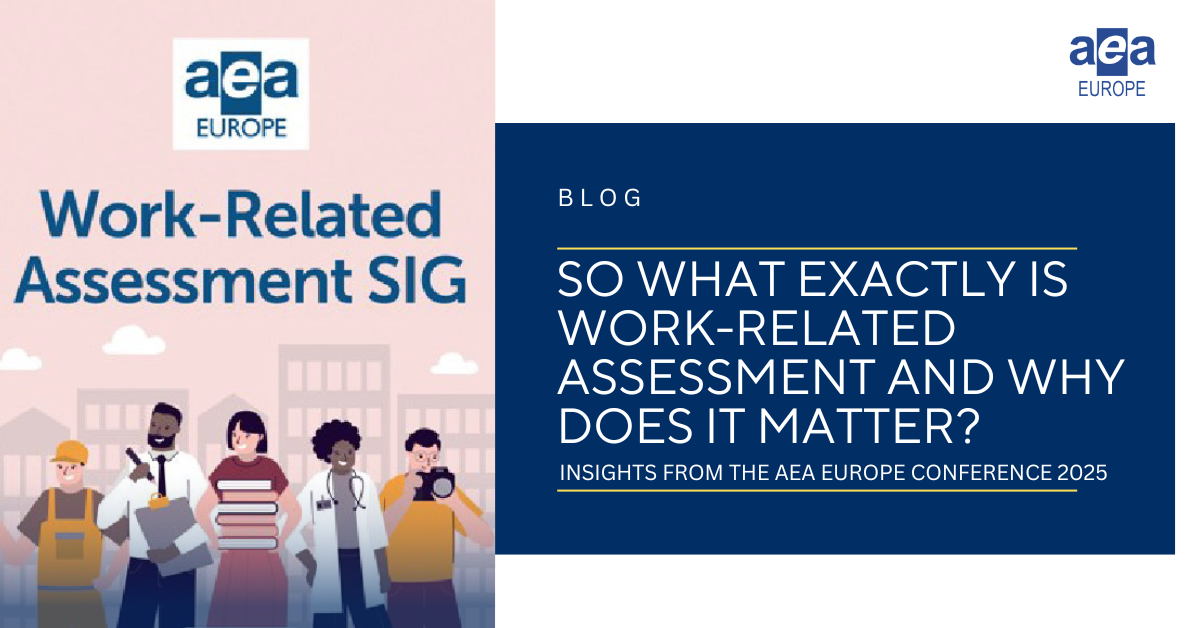
On 24 February, I had the pleasure of chairing the inaugural webinar of AEA-Europe’s Work-Related Assessment Special Interest Group (SiG). I was joined by three panellists from the UK and Australia to explore three questions at the heart of public confidence and professional competence. The discussion revealed shared concerns and productive differences across sectors and countries.
What follows captures the themes as I heard them from the chair’s seat: the case for work-related assessment and the challenge of keeping pace with shifting employer needs, policy and developments in AI.
Why work-related assessment matters: currency, trust, and responsibility
We began with a provocation: if a certificate does not carry value in the labour market and wider society, why issue it? Discussion quickly turned to the broader concept of ‘currency’.
Dr Rebecca Conway used the currency metaphor pointedly: a certificate needs to be trusted by employers, regulators, governments, and learners as evidence of what the holder knows and can do. That places validity at the centre of this discussion because what we claim a qualification represents must align with what it represents in practice.
Yasmin King shared the view of employers that she has worked with in Australia, noting a lack of confidence with employers feel unable to rely on credentials as evidence of job-readiness. In an AI-enabled world, stakeholders seems to be less interested in what candidates can recall and more interested in what they can do in context.
I kept returning to questions of validity in the context of current approaches to work-related assessment. Can these truly generate persuasive evidence that someone can perform reliably amid the complexity of real work?
There was no single answer, but there was consensus that work-related assessment must strongly align with occupational competence if it is to remain credible.
Pressures on the system: research gaps, employer capacity, and competing expectations
Across the UK, Australia, and Europe, job roles, policy and regulatory environments can shift faster than assessment models can be trialled, evaluated, and refined. Rebecca noted that this cadence keeps developers reacting to reform rather than improving design through evidenced-based iteration of assessment methodologies.
Yasmin emphasised the burden of assessment in the workplace on small and micro employers. Authentic workplace assessment demand times, expertise, and use valuable resources. These can be challenging for smaller employers to provide. Assessment systems must be manageable for all employers if we want authenticity without inequity.
This raises a wider question about roles and responsibilities in the assessment ecosystem: who can reasonably carry which parts of the burden, and what support structures are required if we want authenticity without inequity?
Evaluating quality: validity, reliability, and ‘fitness for purpose’
We moved on to explore how we evaluate work-related assessment. This discussion highlighted ways in which assessing workplace competence is not the same as assessing more knowledge-based constructs. Fitness for purpose must be judged against the realities of operational practice, the risks involved, and the decisions we need to justify on the back of assessment outcomes.
Rebecca posed a useful question: when we say someone is ‘competent’ at the end of a programme, what do we actually mean? In many roles the realistic goal is safe, capable, and ready to grow into a job role. Full ‘mastery’ cannot be expected. We need to be honest with our expectations of what learners can achieve at the end of a programme of study and build consensus across employers, individuals and educational policy.
We returned to what counts as ‘authentic’ evidence. A single simulation or workplace ‘snapshot’ rarely supports strong inferences about future performance, pointing instead to evidence gathered over time: multiple observations and portfolio-based evidence.
Concerns around the potential impact of AI on assessment were also surfaced in our discussion. Yasmin questioned whether moving back to more analogue, pen-and-paper approaches to assessment would be scalable or aligned with modern work. Instead, we should assume AI will be present and design assessment to elicit what remains distinctly human such as critical thinking and contextual decision-making. These skills are what employers ultimately care about – safe, responsible work and evidence-based decision making. In the context of AI, we considered what ‘good performance’ in an occupational assessment might look like when professionals are increasingly assisted by AI tools. Do constructs need to change?
We also asked the more constructive question: if AI is becoming part of competent practice, how do we assess the capability to use it well?
Nicola Mellor provided a valuable suggestion: pair an authentic task (where AI use is permitted, because that is increasingly how the job is done) with a second assessment requiring the learner to justify decisions, assumptions, and risks. AI may support production, but we assess whether professional judgement is defensible in context.
System complexity: coherence, speed, and the case for simpler models
A further theme of the discussion was the sheer complexity of the work-related assessment landscape: multiple agencies, regulators, funders, awarding organisations, employers, providers, and learners. Each with legitimate interests, but not always the same vision or use of terminology.
In practice, that complexity slows qualification development, inhibits responsiveness to emerging roles, and creates conflicting requirements. This risks the very currency and public confidence that assessment is meant to protect.
The implication is a push for models that are simpler, more flexible, and potentially more modular while still coherent enough to mean something to employers, learners, and the public.
The audience Q&A provoked lively discussion and the vivid image of our current vocational education and assessment landscape as a ‘colossal, outdated computer’, which is clunky, made up of too many components, and slow to respond to change.
Closing reflections: a crossroads – and a practical way forward
As we closed the webinar, I reflected on the fact that technology, workplaces, and policy contexts are changing rapidly (and sometimes unpredictably). Second, we have a clear mandate to rethink work-related assessment from first principles in ways that protect trust while better reflecting modern work.
Work-related assessment matters because it helps shape who gets to practise, progress, and be trusted in roles that affect the public – from highly regulated professions through to essential services.
If we want credentials to retain their currency, we need clarity of purpose, a more shared understanding of competence, approaches that are robust to AI (and aligned with AI-supported practice), and system designs coherent enough to move at the pace of changing work. Our SiG exists to keep that conversation going—and to turn it into practical learning across contexts. I look forward to welcoming you to the next session.
About the Author

Stuart Shaw
Stuart is an educational assessment researcher, consultant, and author. He is Honorary Associate Professor of University College London in the Institute of Education – Curriculum, Pedagogy & Assessment. Stuart has worked for international awarding organisations for over 20 years and is particularly interested in demonstrating how educational, psychological, and vocational tests seek to meet the demands of validity, reliability, and fairness.
Read the Latest Articles
In addition to the annual conference, the AEA-Europe publishes a range of blogs and organizes webinars related to educational assessment. These activities support ongoing discussion, professional development, and knowledge exchange within the community throughout the year.
Participants and researchers can explore topics connected to assessment practices, policy developments, innovation, and current challenges in the field. Feel free to explore these resources and stay connected with the wider educational assessment community.