
Beyond Cognitive Load: Is There a Parallel Theory for Non-Cognitive Learning?
By Dr Gulbakhyt Sultanova
Imagine two students working on the same mathematics problem. Both have similar prior knowledge. Both receive the same instruction. Both face exactly the same challenge.
Yet their learning journeys unfold very differently.
One student persists through uncertainty, learns from mistakes, and gradually reaches the solution. The other becomes frustrated, loses confidence, and stops trying, even though the necessary knowledge is already there.
Why?
What Cognitive Load Theory Tells Us
For decades, educational researchers have looked to Cognitive Load Theory to understand why learning succeeds or fails. This theory has transformed our understanding of learning by showing that success depends not only on how much mental effort students invest, but also on what kind of mental effort they experience.
One of the theory’s most influential contributions is the distinction between three types of cognitive load:
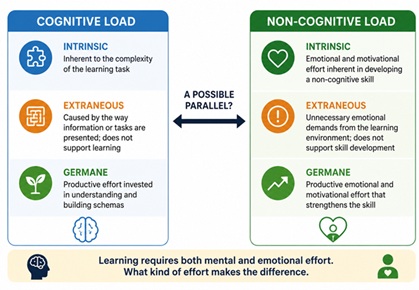
- Intrinsic load – inherent to the complexity of the learning task.
- Extraneous load – created by unnecessary complexity or poor instructional design, and should be minimized.
- Germane load – reflects productive mental effort invested in developing understanding and building cognitive schemas.
This distinction changed how educators think about learning because it demonstrated that not all effort is equally valuable.
Learning is More Than Thinking
But students do more than process information.
They manage frustration when solutions are not immediately obvious. They regulate anxiety before assessments. They decide whether to continue after mistakes. They maintain motivation during periods of uncertainty and repeatedly choose whether to persist or disengage.
These experiences also require effort.
In my opinion article, I introduced the concept of non-cognitive load to describe the emotional, motivational, and self-regulatory effort that accompanies learning (Sultanova, 2025). The idea emerged from a simple observation: students do not learn with their minds alone. They also learn through perseverance, confidence, self-regulation, and the willingness to continue when learning becomes difficult.
The article also proposed that non-cognitive load might parallel Cognitive Load Theory by distinguishing different forms of emotional and motivational effort. The growing interest in the concept since its publication has strengthened my conviction that this theoretical connection deserves further exploration.
Does Non-Cognitive Load Have Its Own Internal Structure?
The fundamental question is therefore not simply whether non-cognitive load exists but:
Could non-cognitive load have an internal structure analogous to cognitive load?
Rather than viewing emotional and motivational effort as a single phenomenon, perhaps we should examine whether different forms of non-cognitive effort play different roles in developing non-cognitive skills.
Consider a student developing perseverance.
Some emotional effort appears unavoidable. Coping with setbacks, tolerating uncertainty, and continuing despite difficulties are inherent parts of developing perseverance itself. Without experiencing challenges, it is difficult to develop the capacity to overcome them.
Other emotional demands may be harmful. Fear of embarrassment, unnecessary classroom stress, unclear expectations, or excessive social pressure may consume students’ emotional resources without contributing to skill development.
Finally, some forms of emotional and motivational effort may be productive. Reflecting on mistakes, deliberately practicing self-regulation, seeking feedback, and choosing to persist after failure may actively strengthen the very skills educators hope students will develop.
A Proposed Framework: Three Forms of Non-Cognitive Load
If these distinctions prove meaningful, they suggest an intriguing parallel with Cognitive Load Theory.
Just as cognitive load can be understood through three dimensions, non-cognitive load might also be considered through three analogous forms:
- Intrinsic non-cognitive load – emotional and motivational effort inherent in developing a particular non-cognitive skill.
- Extraneous non-cognitive load – unnecessary emotional demands created by the learning environment that consume students’ resources without supporting skill development.
- Germane non-cognitive load – productive emotional and motivational effort deliberately invested in strengthening non-cognitive skills.
This is not yet a fully developed theory. Rather, it represents the next stage in developing the original concept of non-cognitive load. Future research will need to clarify definitions, develop measurement approaches, and examine whether these proposed distinctions can be supported empirically.
Why This Matters for Educators
Exploring this possibility seems worthwhile. Educational assessment increasingly values outcomes such as resilience, self-regulation, collaboration, motivation, and growth mindset. However, we often focus on measuring these attributes rather than understanding the processes through which they develop.
Perhaps this is where non-cognitive load can contribute.
If different forms of emotional and motivational effort influence how non-cognitive skills develop, then supporting students may require more than reducing cognitive difficulty. It may also require learning environments that minimize unnecessary emotional burdens while encouraging productive forms of effort.
A New Question Emerges
Perhaps the next step is not only to ask:
“How hard are students thinking?”
but also:
“What kinds of emotional and motivational effort are students investing while they learn, and which of those efforts actually help them grow?”
One of the most influential ideas in learning science began by distinguishing different kinds of cognitive effort. The next frontier may be understanding whether the development of non-cognitive skills follows a similar logic.
I’d love to hear your views about these ideas.
References
Sultanova, G. (2025). Introducing non-cognitive load to the educational discourse. Frontiers in Psychology, 15, 1411102. https://doi.org/10.3389/fpsyg.2024.1411102
About the Author

Gulbakhyt Sultanova
Nazarbayev Intellectual Schools, Kazakhstan
Dr Gulbakhyt Sultanova is an education researcher specializing in educational assessment and learning sciences. She holds a PhD in Education Economics from RWTH Aachen University, Germany, and works at the Center for Pedagogical Measurements at Nazarbayev Intellectual Schools, Kazakhstan.
Her research explores the assessment and development of cognitive and non-cognitive skills, with particular interests in holistic assessment, cognitive load, and emerging approaches to understanding students’ learning experiences. She serves as Chair of the Steering Committee of the Holistic Assessment Special Interest Group at the Association for Educational Assessment–Europe (AEA-Europe).
Read the Latest Articles
In addition to the annual conference, the AEA-Europe publishes a range of blogs and organizes webinars related to educational assessment. These activities support ongoing discussion, professional development, and knowledge exchange within the community throughout the year.
Participants and researchers can explore topics connected to assessment practices, policy developments, innovation, and current challenges in the field. Feel free to explore these resources and stay connected with the wider educational assessment community.