
Reimagining Assessment for a Future-Focused Curriculum
Dr Emma Rawlings Smith
Introduction
As someone who works in an awarding organisation and is a member of AEA Europe’s Holistic Education Steering Committee, I am acutely aware of the important role assessment plays in education. Assessment provides accountability, supports progression and helps ensure fairness for learners. Yet it also powerfully shapes what happens in classrooms. What we choose to assess often becomes what teachers prioritise and what students come to value. This insight formed the starting point for a recent paper I co-authored with Uwe Krause that explores the relationship between curriculum and assessment (Rawlings Smith & Krause, (2026).
Preparing learners for an uncertain future
Many educational systems are increasingly committed to developing critical thinkers who can navigate complexity, uncertainty and rapid change. However, assessment practices do not always align with these ambitions.
Our paper draws on Young and Muller’s (2010) concept of a Future 3 curriculum. At its heart is the idea that education should provide all learners with access to powerful disciplinary knowledge: the concepts, ways of thinking and forms of enquiry that enable them to understand the world beyond their immediate experience. In geography, this means helping students to think geographically, analyse evidence, recognise patterns and relationships, and make informed judgements about complex social and environmental issues.
The curriculum-assessment disconnect
One of the challenges we identify is that much of the existing discussion around powerful knowledge has focused on curriculum design (what should be taught), rather than assessment (how learning is recognised and valued). Yet assessment is not simply a technical process that takes place at the end of learning. It influences curriculum enactment, classroom practice and learners’ experiences throughout their educational journeys.
Importantly, this is not an argument against summative assessment or examinations. Well-designed assessments remain essential. They can provide valuable evidence of learning, support standards and promote public confidence in general qualifications. The question, however, is whether our current assessment architectures always capture the kinds of knowledge, understanding and disciplinary reasoning that future-focused curricula seek to develop.
Seven design principles for Future-3 assessment
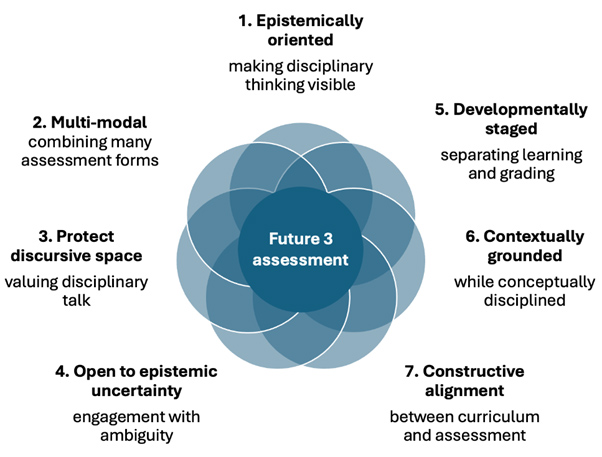
In the paper, we propose seven principles for designing assessment that are closely aligned with Future-3 curriculum thinking. These include making disciplinary thinking visible, creating opportunities for students to engage with uncertainty, valuing discussion and argumentation, using multiple forms of evidence to ensure greater coherence between curriculum, pedagogy and assessment. Rather than focusing solely on what is easiest to measure, these principles encourage us to think about what is most educationally meaningful.
Design principles for Future 3 assessment
Learning from international practice
What we found particularly encouraging was the wealth of international examples demonstrating that alternative approaches already exist. In different ways, systems in Germany, France, Singapore and Peru recognise aspects of disciplinary performance that extend beyond traditional written examinations alone. They illustrate how assessment can support enquiry, reasoning, interpretation and the communication of complex ideas while maintaining rigour and standards.
These examples remind us that there is no single model for reform. Nevertheless, they demonstrate that assessment systems can recognise richer forms of learning when they are deliberately designed to value reasoning, judgement and disciplinary engagement alongside knowledge acquisition.
The questions we need to ask
For those involved in educational assessment, this raises important questions. How can we design assessments that remain reliable and fair while also recognising richer forms of learning? How can we create space for students to demonstrate judgement, analysis and disciplinary thinking? And how can assessment support, rather than inadvertently constrain, the broader purposes of education?
These are not easy questions, and there are no simple solutions. Assessment systems must balance validity, reliability, comparability as well as manageability. Nevertheless, I believe there is real value in continuing the conversation. If we want young people to engage thoughtfully with the complex challenges they will inherit, from climate change to geopolitical uncertainty, we need assessment systems that recognise more than the reproduction of knowledge alone.
Looking ahead
For me, the key message is that assessment should be seen as an integral part of curriculum thinking. When curriculum, pedagogy and assessment work in harmony, they can provide opportunities for all learners to access powerful knowledge and develop the intellectual tools needed to thrive in an uncertain world. The challenge ahead is to align assessment more closely with the knowledge, understanding and ways of thinking that our future curricula aim to develop.
I would be delighted to connect with colleagues who share an interest in the future of assessment.
References
Rawlings Smith, E., & Krause, K. (2026). Reimagining Assessment for a Future 3 Curriculum: Principles and In-sights from Geography. European Journal of Geography, 17(2), S.346-S.358. https://doi.org/10.48088/ejg.e.raw.17.2.346.358
Young, M., & Muller, J. (2010). Three educational scenarios for the future: Lessons from the sociology of knowledge. European Journal of Education, 45(1), 11–27. https://doi.org/10.1111/j.1465-3435.2009.01413.x
About the Author

Emma Rawlings Smith
Emma is a Lead Researcher at AQA, England’s largest awarding organisation, where she leads research on curriculum reform, accessibility and digital assessment. Emma was previously a teacher, examiner and university-based teacher educator and continues to supervise doctoral students. Her wider research interests include curriculum and assessment design, teacher identity and professional knowledge.
Emma contributes to the educational assessment research community as a member of AEA’s Holistic Education Steering Committee and Co-Convenor of BERA’s Curriculum, Pedagogy and Assessment SIG. She is also a Chartered Geographer (RGS) assessor and serves on the editorial boards of London Review of Education and Teaching Geography
Read the Latest Articles
In addition to the annual conference, the AEA-Europe publishes a range of blogs and organizes webinars related to educational assessment. These activities support ongoing discussion, professional development, and knowledge exchange within the community throughout the year.
Participants and researchers can explore topics connected to assessment practices, policy developments, innovation, and current challenges in the field. Feel free to explore these resources and stay connected with the wider educational assessment community.